
Delivering Actionable Research Results
Project Summary
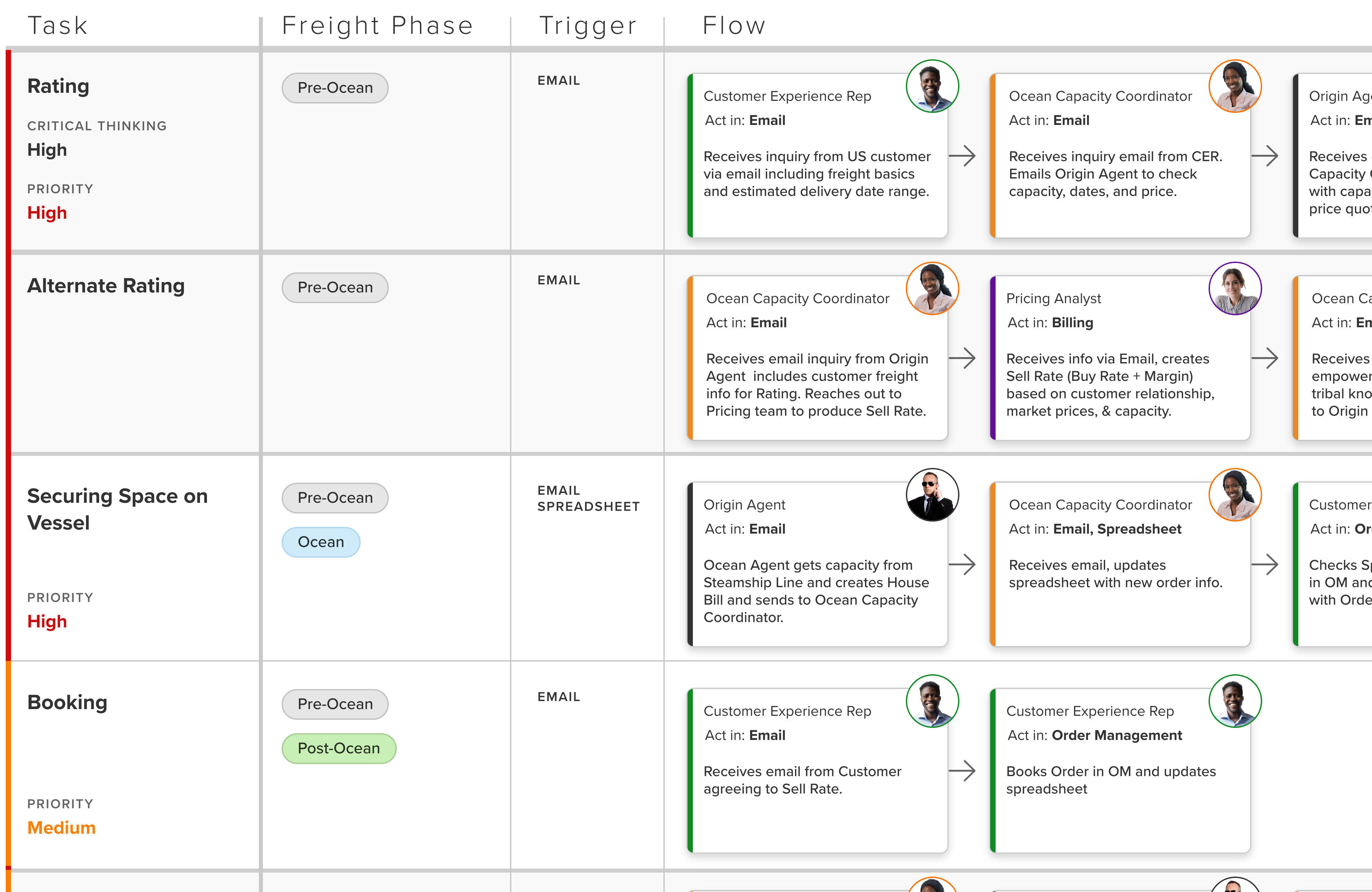
When the business identified an opportunity to expand into international services, I led a research and vision-casting initiative to support this growth. Since there were no existing workflows or processes to build from, we focused on uncovering user needs and aligning the vision with measurable business outcomes. I guided the team in creating two key deliverables to communicate our findings: a Day in the Life diagram and a Task Flow visual. These tools helped the business explore real-world use cases and identify the metrics needed to support and monitor future workflows.
Problem
Context
The international service offering was entirely new territory—there were no structured processes in place. Teams were operating out of spreadsheets, sticky notes, and personal reminders. The business needed clarity on the cost and effort required to build supporting workflows and confidence that we could create a solution that would help them meet their goals.
Research Methods
- User Surveys: I gathered feedback from existing users to uncover their biggest pain points.
- Usability Testing: I conducted multiple sessions to validate our designs, ensuring they aligned with both user expectations and business goals.
- System Analysis: I mapped interactions across roles to make sure our workflows supported both handoffs and exception flows.
Research Findings
- Users struggled to easily identify freight status.
- Current tools didn’t account for international nuances, forcing users to create time-consuming workarounds.
- Manual processes created inefficiencies and limited visibility into critical freight movement.
Solution
My Approach
I led the redesign effort with a focus on simplifying complex, manual processes. We introduced features like international tracking integrations, exception handling, and process automation—all aimed at streamlining the user experience and improving visibility into international freight movement.
Collaboration
I worked closely with business stakeholders to understand their current ad hoc processes and surface opportunities for efficiency. I also partnered with the product manager to prioritize features based on user impact and business value.
Process
Because the requirements were evolving as the business matured in this space, I kept the team aligned through frequent collaboration and rapid design iterations.
- Wireframes: I led the sketching of initial layouts to simplify how tracking information was displayed.
- Prototypes: Leveraged interactive prototypes to validate new features with users.
- Iterations: Based on user and stakeholder feedback, I refined the information hierarchy and optimized the workflow for better usability.
Task Flow Diagram
 Kris King